
When and How to Use SUVAT Equations
Learn when to use SUVAT equations, how constant acceleration appears on acceleration-time, velocity-time and displacement-time graphs, and how to choose the correct SUVAT equation for kinematics problems.
Deepak Kumar ·
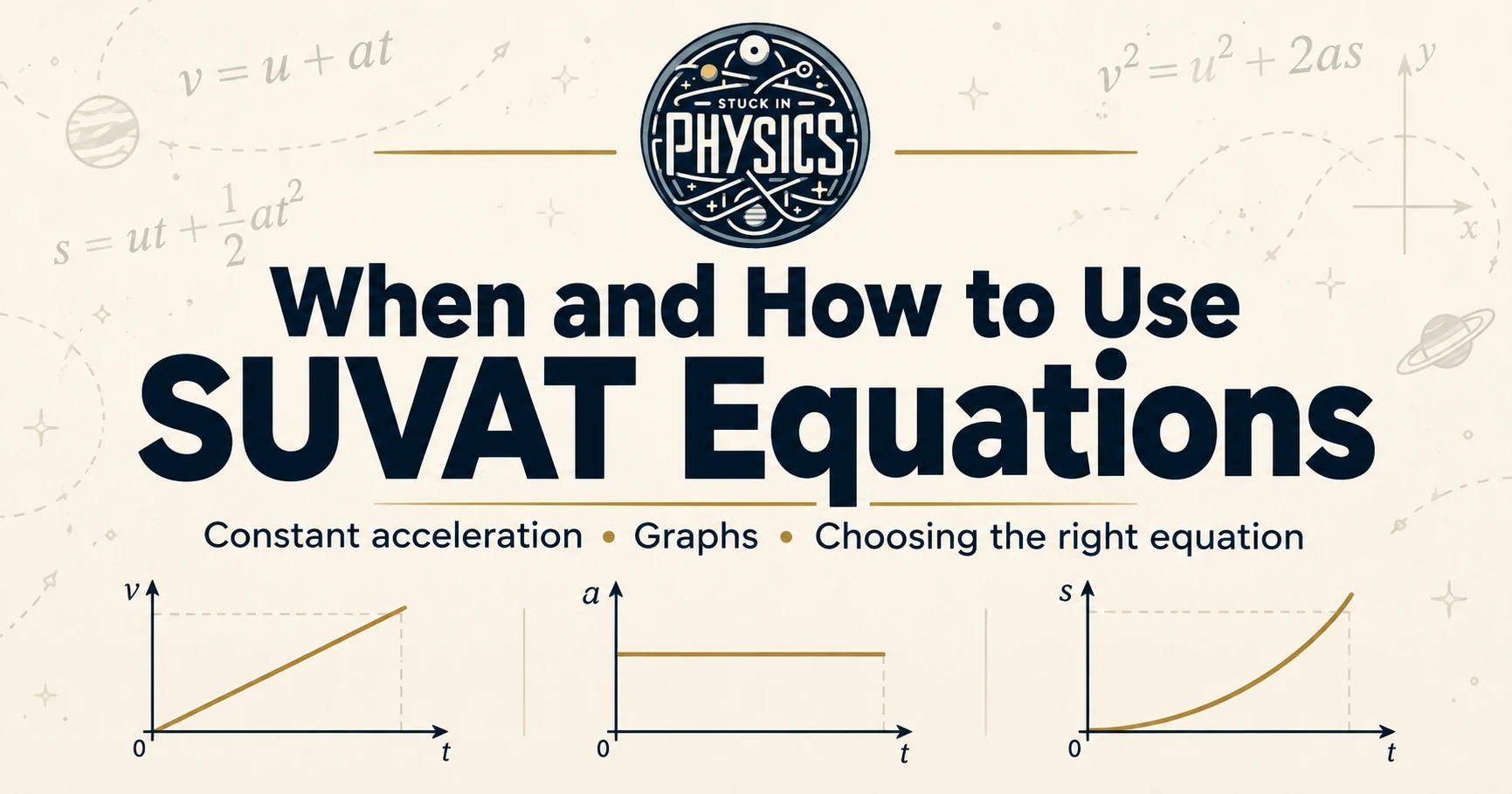
SUVAT equations are some of the first equations students come across in kinematics.
And because there are several of them, it is very easy to fall into this habit:
Read the question → look at all the equations → find one containing similar letters → hope it works.
That is not really how SUVAT is meant to be used.
Before choosing an equation, there is a more important question:
Can I use SUVAT here at all?
The answer depends on one condition:
SUVAT equations can be used when acceleration is constant.
That acceleration can be positive, negative, or even zero.
What matters is that it does not change during the part of the motion you are analysing.
So a car accelerating at a constant rate can be analysed using SUVAT.
A car slowing down at a constant rate can also be analysed using SUVAT.
Even an object moving at constant velocity technically has:
a = 0
which is still constant acceleration.
What SUVAT does not handle directly is motion where the acceleration itself keeps changing.
What does constant acceleration look like on a graph?
Sometimes a question will simply tell you that the acceleration is constant.
Other times, you have to recognise it from a graph.
Acceleration–time graph
If acceleration is constant, the acceleration–time graph is a horizontal straight line.
The value of acceleration stays the same as time passes.
Velocity–time graph
The gradient of a velocity–time graph represents acceleration.
So if acceleration is constant, the velocity–time graph has a constant gradient.
In other words, it is a straight line.
Velocity may increase:
v ↑ linearly with time
or decrease:
v ↓ linearly with time
depending on the sign of the acceleration.
Displacement–time graph
For constant non-zero acceleration, displacement changes quadratically with time.
The displacement–time graph therefore has a parabolic shape.
There is one special case.
If:
a = 0
then velocity is constant and the displacement–time graph becomes a straight line instead.
So, how do you use SUVAT equations?
The way I like to think about SUVAT is as a mystery game.
You have clues.
Some quantities are already known.
One quantity is unknown.
And the SUVAT equations are simply the tools available to solve the mystery.
The five quantities are:
Symbol Meaning
s: displacement
u: initial velocity
v: final velocity
a: acceleration
t: time
So before touching an equation, ask yourself:
What do I know?
Then ask:
What am I trying to find?
Once you know that, choosing the equation becomes much easier.
Choosing the right SUVAT equation
Suppose you know:
u, a and t
and you want to find:
s
You do not know v.
More importantly, you do not need v.
So you want an equation involving:
s, u, a and t
but not v.
That gives:
s = ut + ½at²
That is the basic idea.
You are not trying to find an equation that simply looks familiar.
You are looking for the equation that connects the information you already have to the quantity you are trying to find.
A simple example
A car is travelling initially at:
u = 5 m s⁻¹
It accelerates uniformly at:
a = 2 m s⁻²
for:
t = 6 s
Find the displacement of the car during this time.
Before solving anything, notice the important word:
uniformly
Uniform acceleration means that the acceleration is constant.
So SUVAT can be used.
We know:
u = 5 m s⁻¹
a = 2 m s⁻²
t = 6 s
and we want:
s = ?
We do not know the final velocity v, and we do not need it.
So we choose:
s = ut + ½at²
Substituting the values:
s = (5)(6) + ½(2)(6²)
s = 30 + 36
Therefore:
s = 66 m
And that is it.
The calculation itself was not particularly difficult.
The important part was recognising which equation was appropriate.
One common mistake: negative acceleration
Negative acceleration does not mean that SUVAT cannot be used.
For example, imagine throwing a ball vertically upwards.
If we choose upward as the positive direction, the acceleration due to gravity is approximately:
a = −9.81 m s⁻²
The negative sign simply tells us that the acceleration is directed downward.
It is still approximately constant near the surface of the Earth.
So SUVAT can still be used.
This is also why choosing a positive direction before substituting values is important.
The main idea
If you remember one thing from this article, remember this:
SUVAT equations are used when acceleration is constant.
After that, treat the problem like a mystery.
Identify what you know.
Identify what you need.
Then choose the equation that connects those quantities while avoiding unnecessary unknowns.
The more problems you solve, the less this feels like searching through formulas and the more natural the choice of equation becomes.
Want to see SUVAT used in an actual problem?
I have also made a video explaining SUVAT equations and how to approach these questions step by step.
Watch the SUVAT lesson on YouTube →