
IB Physics HL Paper 2 Analysis: Unit Weightage and Most-Tested Concepts
Explore IB Physics HL Paper 2 unit weightage and the top 10 most-tested concepts, based on the revised syllabus from the 2025–2026 exam sessions.
Deepak Kumar ·
Which units carried the most marks in IB Physics HL Paper 2? Which concepts appeared repeatedly, and how were they tested?
I analysed eight papers across May 2025, November 2025 and May 2026, covering 720 marks. The results show both the distribution of marks and the types of understanding students needed to demonstrate.
Unit-wise weightage
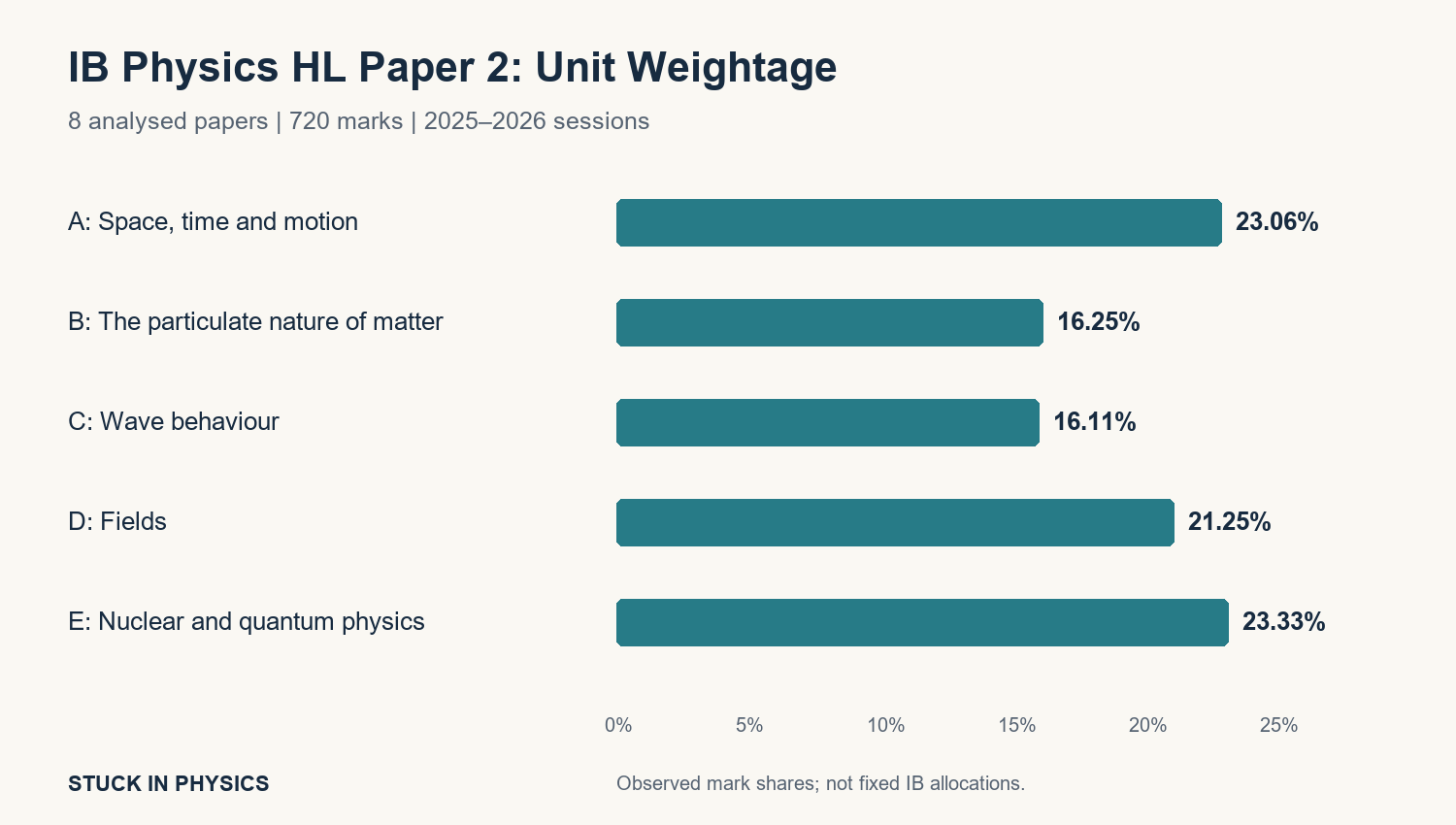
Nuclear and quantum physics had the largest share, narrowly ahead of space, time and motion. Together with fields, these units accounted for approximately 68% of the analysed marks.
The particulate nature of matter and wave behaviour had almost equal shares, each contributing approximately 16%.
However, all five units received marks in every paper analysed. These percentages describe the sample; they are not fixed IB allocations for future exams.
Top 10 most-tested concepts
These concepts appeared most frequently across the eight papers. The table is ordered by paper frequency, with total marks used to break ties. Entries with equal frequency and marks share the same priority.
Concept | What the questions tested |
|---|---|
First law of thermodynamics and thermodynamic processes | Internal-energy changes during adiabatic expansion and compression; heat transfer in gas cycles; temperature changes at constant volume. |
Lenz’s law and magnetic braking | Induced-current direction; forces opposing a conducting rod’s motion; decreasing oscillation amplitude when a circuit is connected to a load. |
Spacetime diagrams and simultaneity | Drawing light world lines and moving-frame axes; identifying simultaneous events; determining relative speed from spacetime diagrams. |
Uniform-acceleration kinematics | Calculating speed, acceleration and travel time; analysing free fall and projectile motion; identifying velocity and acceleration directions. |
Work–energy theorem | Finding work from force–distance graphs; calculating speed after energy transfers; determining stopping distance against resistance. |
Charged-particle motion in an electric field | Relating accelerating voltage to kinetic energy; calculating acceleration and deflection between plates; deciding whether a particle strikes a plate. |
Charged-particle motion in a magnetic field | Deriving and using the circular-path radius; explaining constant speed; interpreting changes in path curvature. |
Buoyancy and floating equilibrium | Balancing upthrust and weight; finding submerged fractions; calculating acceleration and payload mass in fluids. |
Conduction and thermal conductivity | Explaining conduction microscopically; calculating heat-transfer rates; interpreting temperature gradients and changing heat loss. |
Conditions required for nuclear fusion | Explaining high core temperatures and densities; identifying fusion products; relating electrostatic repulsion to the energy needed for fusion. |
How these concepts were tested
Thermodynamics required tracking energy through a process
Questions asked students to distinguish between heat transfer, work and internal-energy change.
For example, adiabatic expansion required understanding that a gas can change temperature even when no heat is transferred. Other tasks involved constant-volume heating and stages of a gas cycle.
The process conditions mattered: students needed to identify what remained constant before choosing an equation.
Electromagnetism combined calculations with explanations
Electric-field questions linked acceleration through a potential difference to subsequent motion between charged plates. Students calculated quantities such as speed, acceleration and the distance travelled before reaching a plate.
Magnetic-field questions tested circular motion through the relationship
for motion perpendicular to a uniform magnetic field. They also asked students to explain why the magnetic force changes the particle’s direction while leaving its speed unchanged.
Induction questions extended beyond finding a current direction. Students explained magnetic braking and damping, connecting the induced current to the force opposing motion and the transfer of mechanical energy.
Mechanics tested graphs, forces and energy transfers
The work–energy theorem appeared in questions involving variable forces, resistance and changes in gravitational potential energy.
Students needed to recognise that the area under a force–distance graph represents work, then connect that work to a change in kinetic energy.
Buoyancy questions also required careful force analysis. Floating equilibrium involved balanced forces, while accelerating objects required a non-zero resultant force. The context ranged from submerged objects to balloons carrying a payload.
Relativity and thermal physics required interpretation
Spacetime questions involved constructing and reading diagrams: drawing world lines, identifying moving-frame axes and determining whether events were simultaneous for a particular observer.
Conduction questions combined numerical heat-transfer calculations with explanations of temperature gradients and changing cooling rates.
Fusion questions asked why the core conditions were necessary. Answers needed to connect temperature to particle energies and density to the likelihood of nuclei interacting.
Calculations were only part of the paper
In this analysis, calculations accounted for 55.8% of the marks, while explanations accounted for 28.8%. The remaining marks involved diagrams, derivations, recall, data reading and modelling.
These categories describe the main response required by each subpart. Even a calculation could depend on interpreting a physical situation correctly.
When practising a concept, check that you can:
Choose and apply the appropriate equation.
Explain the physical reasoning behind your method.
Interpret a relevant graph or diagram.
State the conditions under which your approach applies.
What should this mean for your revision?
Give substantial practice time to space, time and motion; fields; and nuclear and quantum physics, while keeping all five units in your revision plan.
Use the recurring concepts above to identify gaps. Then practise complete multipart questions, where successive parts may require different principles.
A low weighting in this sample does not make a topic safe to skip. Eight papers provide useful evidence about what has been tested, but they cannot establish what will appear next.
Method: Each marked subpart was assigned to one primary unit and concept to avoid double-counting. Supporting concepts may therefore be used more widely than their direct allocation suggests. The sample contains variants from three exam sessions; the classifications are analytical rather than official IB weightings.