
Absolute and Percentage Uncertainty
Learn how to calculate absolute and percentage uncertainty in IB Physics, combine uncertainties, and check experimental agreement with a worked pendulum example.
Deepak Kumar ·
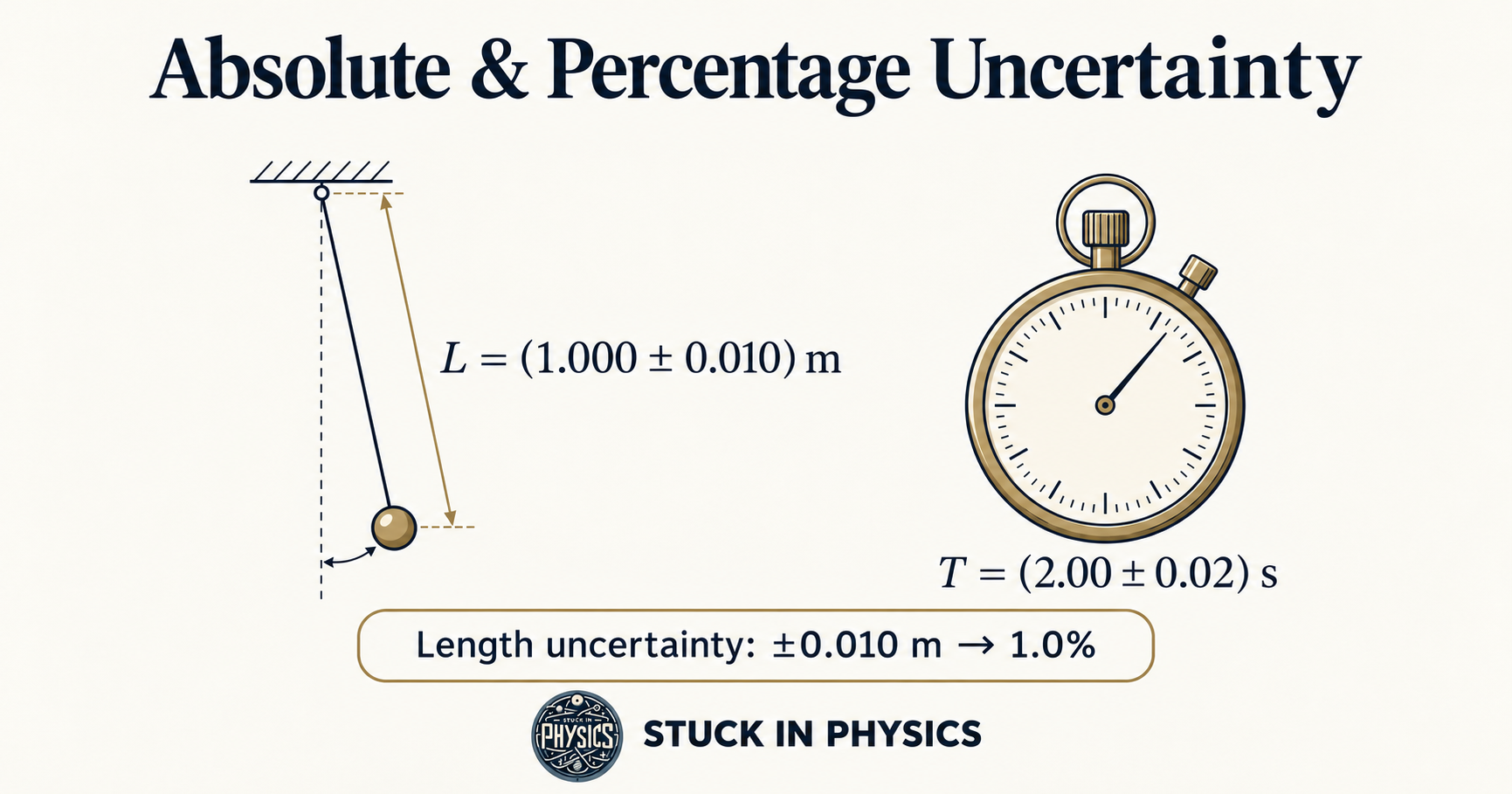
A measurement is more useful when you report how uncertain it is, not just its value.
For example:
Here, is the measured length and is its absolute uncertainty.
The reported interval runs from:
This communicates the estimated uncertainty. It does not guarantee that every possible source of error has been accounted for.
Absolute, fractional and percentage uncertainty
These are three ways of expressing the same uncertainty.
Type | Calculation | Units |
|---|---|---|
Absolute uncertainty | Same as the measured quantity | |
Fractional uncertainty | No units | |
Percentage uncertainty | Percentage |
For our length measurement:
Therefore:
Divide the uncertainty by the measured value—not the other way around.
How do you combine uncertainties?
For the usual approximate uncertainty calculations in IB Physics, use these rules.
Adding or subtracting: add absolute uncertainties
If:
then:
Even when subtracting measurements, add their absolute uncertainties.
For example, two measured lengths are:
Their difference is:
Multiplying or dividing: add percentage uncertainties
If:
then:
For example, if distance has a percentage uncertainty of and time has a percentage uncertainty of , the calculated speed has approximately:
Powers: multiply the percentage uncertainty by the magnitude of the power
If:
then:
So:
Squaring a quantity doubles its percentage uncertainty.
Taking its square root halves its percentage uncertainty.
Taking its reciprocal leaves its percentage uncertainty unchanged.
Exact numerical constants do not contribute uncertainty. For example, the and in a formula are not uncertain measurements.
Convert back to absolute uncertainty
Once you have the percentage uncertainty in your answer:
Suppose a calculated acceleration is , with a percentage uncertainty of :
Using one significant figure for the final uncertainty, report:
Keep extra digits during calculations. Round the final value to the same decimal place as its absolute uncertainty, following any precision instructions in the question.
Uncertainty is not percentage error
Percentage uncertainty describes the uncertainty associated with your measurement or calculated result.
Percentage error compares your result with an accepted value:
A small uncertainty does not automatically mean an accurate result. A systematic error can give a precise result that disagrees with the accepted value.
To check agreement, calculate:
If the accepted value lies within this interval, the result is consistent with the accepted value within the stated uncertainty. That supports agreement; it does not prove the experiment is free from error.
Try it: finding gravitational acceleration with a pendulum
For a simple pendulum oscillating at a small angle:
A student measures the length from the pivot to the centre of the bob:
The measured period is:
Treat the numerical constants as exact and use as the accepted value of .
Rearrange the equation to make the subject.
Calculate the experimental value of .
Calculate its percentage uncertainty.
Report with its absolute uncertainty.
Find the lower and upper limits of the reported result.
Does lie within that interval—and what can you conclude about the agreement?
Solution:
Rearranging:
Substituting:
The percentage uncertainty in length is:
The percentage uncertainty in period is:
Since is proportional to :
Therefore, the percentage uncertainty in is:
The absolute uncertainty is:
Reporting the uncertainty to one significant figure:
The reported interval is:
The accepted value, , lies within this interval.
The experimental result is consistent with the accepted value within its stated uncertainty.